

[This is a guest blog by Juraj Šarić. Juraj is a strength & conditioning coach with a masters degree in Kinesiology from the University of Zagreb, Croatia. He has experience coaching at a variety of levels and is currently working as a conditioning coach for boxing. His background is in swimming, waterpolo and martial arts. At the moment, he is taking part in the Athletic Lab Coaching Mentorship program.]
INTRODUCTION
 In modern day sport, it is critical to implement training strategies wisely. The biggest question for sport performance professionals is: What to develop and which physical qualities to address in a short amount of time you have with your athletes? Given the fact that muscle cross-sectional area greatly correlates to muscular strength, some training plans should be hypertrophy focused [1]. Moreover, bodybuilding is a sport which primarily puts an emphasis on muscular growth. If we were to follow old-school bodybuilding ideology, we would like to introduce more modalities into our training program. As Arnold Schwarzenegger once said: “You have to go and use the SHOCKING PRINCIPLE. You gotta shock the muscle.” Having said that, there is a growing body of evidence suggesting improvements in muscle mass when implementing blood flow restriction training. Therefore, this can be a viable option to use when hypertrophy is the main goal of the training.
CAUSING MUSCLE HYPERTROPHY
Before going into actual training for inducing positive changes in a cross sectional-area (CSA), we have to consider the physiological background which causes muscular hypertrophy. It is hypothesized that there are three primary mechanisms that trigger muscle growth [1]:
- Mechanical tension
- Metabolic stress
- Muscle damage (microtrauma)
 Both mechanical tension and metabolic stress act together to facilitate a great number of secondary associated mechanisms; such as increased fast-twitch fiber recruitment, systemic and localized hormone production (ex. growth hormone), cell swelling, reactive oxygen species (ROS) production, etc. [2]. All of these help elicit muscle growth via activation of signaling pathways. It must be noted that some of these mechanisms (responsible for muscle hypertrophy) are not being stimulated to the greatest extent via metabolic stress. Rather, they are mainly associated with higher levels of mechanical tension (increased recruitment of fast-twitch muscle fibers and ROS production) [2]. In a practical sense, that would mean that they are more subjected to a change via high intensity training. However, with all of that being said, it is still unclear to which extent these primary ingredients affect every other mechanism that helps induce muscular growth. With this in mind, it might be beneficial to use different modalities to optimize hypertrophy gains.
WHAT IS BLOOD FLOW RESTRICTION?
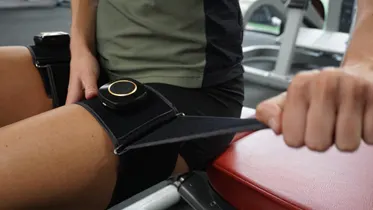
 Blood flow restriction (BFR) training, is a training method that makes use of specialized pressure cuffs to occlude blood flow (partial blockage of a blood vessel) to the working limb while performing a given exercise. Cuffs are placed at the most proximal end of a limb (i.e., top of the thigh or arm) regardless of how distal the targeted muscle group may be for a given exercise (such as the calves). A variety of cuffs can be used to achieve a desired effect, such as elastic or nylon pneumatic cuffs, standard blood pressure cuffs and even simple elastic or nylon wraps. KAATSU cuffs, SAGA Fitness cuffs, and Air bands are just a few of many pneumatic brands that can be found. Apart from the elastic or nylon wraps, pneumatic cuffs would be inflated to a desired pressure. This pressure should be individualized to some extent for every person.
When using a BFR cuff, you should aim for the pressure to be high enough to occlude venous return from the muscle but low enough to maintain arterial inflow into the muscle [3]. BFR seems to follow “Hormesis Theory” to some extent. This theoretical postulate states that some stimulants may produce favorable biological effects in small doses while producing harmful effects in moderate to high doses. In this case, low to moderate pressure should produce a beneficial environment for muscle hypertrophy while higher pressures may even decrease benefits of exercise and increase health risks. The main goal here is to get the optimal response from our athletes when implementing such a stimulus. These responses may vary depending on different modalities and intensities used in a training session.
Typically, a minimum intensity threshold for eliciting hypertrophy is around +65% of one repetition max (1RM). However, recent studies suggest that training intensity and volume thresholds for strength and hypertrophy are lowered when using BFR [4]. Impressively, increases in muscle hypertrophy and strength have been observed in BFR training with intensities as low as 20% of 1RM [5]. Conversely, it should be noted that BFR causes lower levels of muscle recruitment than high-load exercises. Therefore, we can reasonably assume that neurological stimulus from BFR is most likely inadequate to elicit beneficial adaptations when rapid force of production is relevant [11]. A recommendable strategy would be to use a high-load training session coupled with low-load BFR auxiliary exercises. This should provide an additional stimulus for muscle development [11].
PHYSIOLOGICAL BASIS FOR BLOOD FLOW RESTRICTION TRAINING
When designing training programs for athletes, we need to understand what is happening inside of their bodies so that we can better understand what kind of changes to expect when applying certain stimuli. Sometimes our bodies don’t “speak” the same language as we do. They don’t understand repetition, sets, rest time, etc., but they will understand hormonal change, muscle load, time under tension and so on. The next section of this article will give us a better understanding of what our bodies experience when blood flow restriction is being used.
“Body’s Language”
 It was commonly believed that resistance training could only induce muscle growth by using high exercise intensities (more than 65 % of 1RM) [2]. Conversely, modern day research indicates that blood flow restriction training causes higher blood lactate accumulation compared to traditional resistance training. If we look back, this build up of metabolites is one of the three main stimuli to promote muscle hypertrophy. This would suggest that we can produce great metabolic stress even with lower training intensities, and therefore achieve the desired adaptation. In fact, some studies argue that this build up acts as the main driving factor for muscle hypertrophy when using BFR training [2]. On a similar note, increase in lactate production has also shown to facilitate increase in growth hormone (GH) production following exercise [3] [5]. Although the exact mechanisms are unclear, it would appear that reduced blood flow induces a hypoxic environment (promotes lactate build up) in exercising muscle which seems to have an additive effect on muscle hypertrophy as well as the ability to attenuate muscular atrophy. [2]. Another potential mechanism of hypoxia is its effect on reactive oxygen species (ROS). ROS are believed to be an important array of molecules shown to promote muscular and cardiac growth [1].
Furthermore, EMG response seems to increase for lower intensity exercises when using BFR. This is important to know since EMG signaling can be a good representation of muscle activation. Following this logic, it can be said that using BFR may stimulate muscle firing. Moreover, EMG signaling has been shown to rise when gradually increasing pressure on muscles. The explanation for these phenomena seems to be “metabolic overload” (i.e. depletion of phosphocreatine stores and decrease in muscle pH). Improved recruitment of motor units seems to happen because of a muscle fiber inhibition caused by increased lactic acid accumulation [4] [3]. Remarkably, greater recruitment of fast twitch muscle fibers (type II fibers) has been observed even at low training intensities when implementing BFR. This is explained through the lower supply of oxygen for slow twitch (type I) fibers. To compensate for this “slack” in type I fiber recruitment, fast twitch fibers are recruited to maintain muscular force and protect against conduction failure. If we couple these findings with the fact that type II muscle fibers seem to be more responsive to hypertrophy (in contrast to type I fibers) [2], we can easily see the relevance for implementing BFR in our programs.
Additionally, BFR can also cause muscle cell swelling (acute increase in muscle thickness) by shifting fluid from plasma to the cell itself [3]. It is believed that this liquid shift may serve as a regulator of cell functioning by having an impact on anabolic processes through increased protein synthesis as well as decreased proteolysis [1].
In summary, when BFR is applied, favorable changes in muscle hypertrophy occur because of:
- ↑ Lactate accumulation
- ↑ Levels of hypoxia
- ↑ EMG signaling (for lower intensity exercises)
- ↑ Fast fiber twitch recruitment (for lower intensity exercises)
- ↑ Muscle swelling
PRACTICAL APPLICATIONS FOR BLOOD FLOW RESTRICTION
Having devices capable of regulating restriction pressure (in-research environment) seems a bit expensive for most practitioners. A reasonable solution for this problem could be elastic or nylon wraps. Combining these with “perceived tightness scale” seems to improve muscle hypertrophy to a similar extent as when using pressurized cuffs. This scale was introduced by Wilson et al. [6], and it ranges from 1-10, where 0 means no pressure and 10 means intense pressure with pain. In this study, all of the subjects would perform BFR training under moderate pressure of 7 out of 10 perceived tightness [12]. This particular pressuring would consistently result in complete occlusion of the veins, but not arteries. Another way of using BFR without expensive equipment would be to use palpation of radial artery (for upper body) or posterior tibial artery (for lower body). If you can’t feel any pulse, the wraps should be loosened [7].
If pneumatic cuffs are available, it is advised to use an individual approach to pressuring. One proposed method suggests to use a percentage of the minimum pressure needed to completely occlude blood flow to a limb in resting state [7]. In addition to this method, the percentage of brachial systolic blood pressure (bSBP) has also been used in several research studies. It is worth mentioning that some studies found bSBP to correlate poorly with arterial occlusion [8], so it may be advisable to use percentage of AOP (arterial occlusion pressure) as an occlusion indicator. In any case, low to moderate pressuring of the limbs seems to elicit the greatest hypertrophic response.
 Also, while applying pressure with training cuffs, one should keep in mind that the width of the cuffs matters. Usually, this can range from 3 to 18 cm and it has been shown that the usage of narrower cuffs usually achieves lower arterial occlusion compared to wider cuffs for the same pressure applied (ex. 130% of bSBP) [9]. Therefore, when designing a training protocol with wider cuffs, coaches should put less pressure to gain the desired effect. On top of that, we practitioners should further consider individual differences when tailoring training programs. Studies suggest that individuals with larger limbs require greater pressuring of the cuffs [7]. On the same note, although cuff pressuring is a matter for further research it appears to be dictated, partially, by intensity of an exercise. Studies suggest that a higher restriction should be applied (ex. 80% arterial occlusion) if the load is less than 30% of maximum [7]. Anything going beyond that, moderate pressuring (ex. 40% arterial occlusion pressure) seems to be efficient to induce muscle hypertrophy response [7].
The most commonly used protocol for research studies is one set of 30 repetitions followed by three sets of 15 repetitions (75 repetitions) with starting pressure at 160 mmHg. Pressure would then be raised by 20 mmHg each day until reaching 240 mmHg [10]. This protocol would be done with 30s rest periods in between sets without taking cuffs off. Not wearing cuffs during rest periods may decrease metabolic stress which can, in the end, lead to limited hypertrophy adaptations [8]. While this exact training protocol probably won’t be used in everyday performance gyms, there are some guidelines listed in figure below that should be followed [12].
BLOOD FLOW RESTRICTION CONTRAINDICATIONS
The main thing that should be avoided while doing BFR is complete arterial occlusion. Essentially, we don’t want our arm to go “all blue” on us. Complete arterial occlusion has been seen to occur when setting wide cuffs at 130% of bSBP (brachial systolic blood pressure) [3]. This is a “red flag” since it can cause formation of thrombus. Moreover, the risk of forming thrombus goes up if the exercise is done to a point of muscle failure. Another thing to worry about would be slowing down of nerve conduction velocity. On top of that, complete arterial occlusion can lead to decreased training effectiveness since it will result in a decreased work volume for our athletes. Moreover, athletes should keep in mind not to lift heavy weights or use vascular restriction while undergoing any kind of cardiac rehabilitation. Restrictive cuffs should be placed on both limbs simultaneously but it is not advisable to utilize them for upper and lower body concurrently [5]. Keeping the risk factor in check, if you avoid putting too much pressure on the targeted muscle, you should feel safe performing this type of training.
SUMMARY
The fact that BFR is usually paired with lower intensity exercises (20-40% 1RM), compared to traditional work, opens up a new door of possibilities for conditioning. Lower intensities imply less mechanical stress on an athlete. Given these facts, it may be advisable to use this method for a couple of reasons:
- When the end goal is to relieve stress on the body while maintaining or improving muscle hypertrophy [4]
- When athletes are in their competitive season to avoid high volume, high intensity training so that we don’t over train them [10]
To this end, BFR may serve as a good medium to counter potential negative effects of high mechanical loads since it does not appear to produce significant muscle damage [11]. What is more, pressure applied needs to be tailored for the individual. Meaning, one should keep in mind cuff width, limb size, and personal arterial occlusion pressure before implementing BFR. Typically, low to moderate pressuring of the limbs would be used. Moreover, some of the pathways eliciting muscle hypertrophy mainly rely on mechanical tension. With this in mind BFR should not fully replace traditional resistance training which uses higher loads. So, to end it all… To get the “biggest bang for your buck” BFR should be accompanied by the higher intensity loading found in traditional hypertrophy aimed training.
References
- Schoenfeld, B. J. (2010). The mechanisms of muscle hypertrophy and their application to resistance training. The Journal of Strength & Conditioning Research, 24(10):2857–2872.
- Pearson, S. J. and Hussain, S. R. (2015). A review on the mechanisms of blood-flow restriction resistance training-induced muscle hypertrophy. Sports medicine, 45(2):187–200.
- Loenneke, J., Thiebaud, R., Abe, T., and Bemben, M. (2014). Blood flow restriction pressure recommendations: the hormesis hypothesis. Medical hypotheses, 82(5):623–626.
- Karabulut, M., Abe, T., Sato, Y., and Bemben, M. (2007). Overview of neuromuscular adaptations of skeletal muscle to kaatsu training. International Journal of KAATSU Training Research, 3(1):1–9.
- [Martinez et al.] Martinez, N., Lilla, C., and Renteria, M. Considerations of blood flow restriction (bfr) training—a case for injury prevention and maximizing strength for tactical personnel.
- Wilson, J. M., Lowery, R. P., Joy, J. M., Loenneke, J. P., and Naimo, M. A. (2013). Practical blood flow restriction training increases acute determinants of hypertrophy without increasing indices of muscle damage. The Journal of Strength & Conditioning Research, 27(11):3068–3075.
- Mattocks, K. T., Jessee, M. B., Mouser, J. G., Dankel, S. J., Buckner, S. L., Bell, Z. W., Owens, J. G., Abe, T., and Loenneke, J. P. (2018). The application of blood flow restriction: lessons from the laboratory. Current sports medicine reports, 17(4):129–134.
- Patterson, S. D., Hughes, L., Warmington, S., Burr, J., Scott, B. R., Owens, J., Abe, T., Nielsen, J. L., Libardi, C. A., Laurentino, G., et al. (2019). Blood flow restriction exercise: considerations of methodology, application, and safety. Frontiers in physiology, page 533.
- Loenneke, J. P., Fahs, C. A., Rossow, L. M., Thiebaud, R. S., Mattocks, K. T., Abe, T., and Bemben, M. G. (2013). Blood flow restriction pressure recommendations: a tale of two cuffs. Frontiers in physiology, 4:249.
- Abe, T., Kawamoto, K., Yasuda, T., CF, K., Midorikawa, T., and Sato, Y. (2005). Eight days kaatsu resistance training improved sprint but not jump performance in collegiate male track and field athletes. International Journal of KAATSU Training Research, 1(1):19–23.
- Scott, B. R., Loenneke, J. P., Slattery, K. M., and Dascombe, B. J. (2016). Blood flow restricted exercise for athletes: A review of available evidence. Journal of science and medicine in sport, 19(5):360–367.
- Lorenz, D. S., Bailey, L., Wilk, K. E., Mangine, R. E., Head, P., Grindstaff, T. L., and Morrison, S. (2021). Blood flow restriction training. Journal of athletic training, 56(9):937–944.












Leave A Comment