

 Conditioning has not played a huge role in softball, and now-days most of the general training programs softball players are following do not exactly meet their sport-specific needs. Since softball incorporates many skills, and one of the most important being the ability to react proficiently to every aspect of the game, a softball-specific training program is crucial in order to maximize this ability.
In order to be able to design a softball-specific training program we must first understand the specific demands of the game. In this article I will address important factors a softball player must train in order to improve and maximize their athletic performance.
Energy Systems:
In terms of metabolic training, softball players should train overall fitness in the off-season, but the most important factor to train is the ability to make explosive movements for a short period of time. Therefore, it is the ATP-PC energy system that fuels just about every action in softball. Training the ATP-PC energy system involves sessions of repetitive 10-15 second bouts of maximum intensity work, with approximately two minutes of rest in-between to allow the system to replenish itself.
Note that when conditioning ATP-PC system, it is very important to build in plenty of rest. It is also important to stop the training session if the quality of the movements or the players power decreases significantly, because when this happens you are beginning to work on power-endurance, which is counterproductive if your goal is to only increase the ATP-PC systems capacity.
Strength:
The key here is developing muscular power, power is a function of speed + strength. But first it is ideal to have a base in general strength, as well as maximal strength, which serves as a foundation to build muscular power. Softball players specifically need throwing power, acceleration power, and some muscular endurance is always beneficial especially for the pitchers.
The game of softball requires a variety of skills and movements to execute an action correctly. Therefore, full body training is essential. For example: when throwing the ball, shoulder strength is not the only factor that comes into play. Back strength, hips, and core strength also play an important role in the throwing motion. A strong core and hips are even more important for developing more power when hitting.
It is also important not to neglect the stabilizers, more specifically the shoulder (lower trapezius muscle), core (transversus), and knee (gluteus medius muscle) stabilizers, to keep the players injury free. Strengthening the stabilizer muscles helps minimize harmful joint translations and create a solid body framework. Core training is also essential to achieve better performance. Strengthening the core allows for an increase in torso power and joint stability, while also reducing the chance of injuries and enhancing movement efficiency. Stability ball exercises are good for strengthening those stabilizing muscles, and med ball exercises will help develop a powerful trunk.
Speed, Quickness, and Agility:
Softball is a game is largely about speed, and just to demonstrate how big I am talking allow me to break it down a little farther. Elite softball pitchers can top speeds around 70mph, and after they take their stride off the mound they are generally around 37ft away from home plate. That means it takes about 0.35 seconds for the ball to reach the plate, which is actually faster than it takes a 100mph fastball in baseball to reach home plate (~0.38 seconds). So after locating, and identifying a fastball a batter has about 0.025 seconds to decide to swing. This is 55% less time than a major league baseball player has (~0.055 seconds).
Batting is not the only aspect of softball where speed and quickness plays an important role, we must also think about fielding. When balls come off the bat, they are approaching speeds around 100mph. So, a short stop fielding the ball has less time to react and catch a line drive than a tennis player has reacting to a Serena Williams serve. When fielding grounders, an infielder has to get the ball to first base in less than 3.12 seconds, and when you have a left-handed slap hitter the infielders have even less time to get the ball to first base.
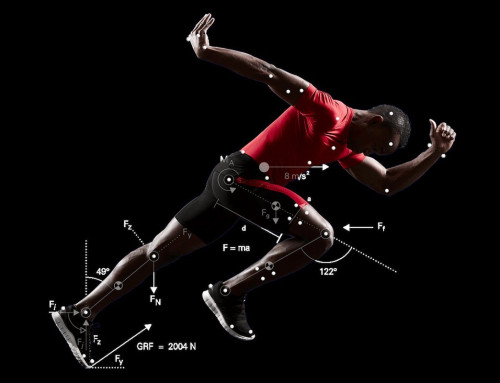
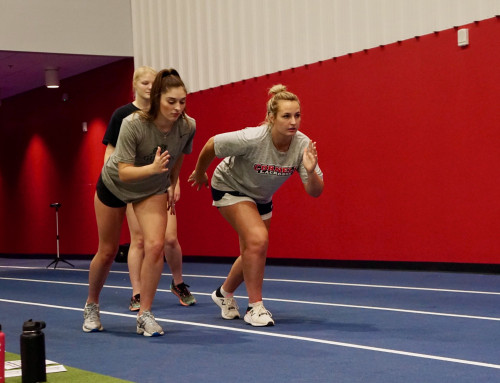
Therefore, a couple of factors you should considering during training would be lateral movements, multi-directional quickness/speed, acceleration, and linear speed. In order to develop these performance factors training sessions should include footwork drills, running form drills, agility drills, lateral movements, sprints, and of course a lot of quick explosive actions/movements.
Flexibility:
Softball requires a player to have the ability to move through a full ROM, and a greater ROM contributes to improved athletic performance while also minimizing the risk of an injury. Therefore, it is wise to implement a flexibility program focusing on the major muscle groups during the pre-season.
In season, a proper dynamic warm-up is essential to prepare the body to perform adequately and minimize the risk of an injury, while static stretching is a good idea to incorporate in a cool-down.
Coordination and Balance:
Movements requiring coordination specifically related to softball include hitting a ball, fielding a ball, executing plays while in motion, and throwing a ball to hit a specific target. Hand-eye coordination is most certainty important in the game of softball as well. Although coordination is more of a natural, inherited ability based on a player’s genetics, being exposed to a variety of skills during the pre-adolescent stage helps develop coordination. Sport-specific training involving exercises with progressively increased complexity will also help the development of coordination.
Good balance, which is closely related to coordination, is also an essential factor for a softball player to posses. Balance will enhance performance during the execution of plays, as well as reduce the chance of an injury. Balance can be trained by incorporating stability ball and balance board exercises, these exercises put the body in an unstable environment allowing the muscles to react and maintain stability.
Finally, in order for a softball-specific training program to be successful one must take into consideration the players position, fitness level, any prior injuries, and of course the specific demands of the game. The specificity principle is key here.
References
- Dagenais, M. (2003, 05 30). What is specific to softball Retrieved 09 15, 2014, from Bodybuilding.com: www.bodybuilding.com/fun/softball.htm
- ESPN-W. (n.d.). Sport Science: The Speed of Softball. Sport Science: The Speed of Softball . ESPN-W.
- Nayyar, N. (2011, 09 07). Understanding Role of Stabilizer Muscles. Retrieved 09 15, 2014, from WomenFitness: www.womenfitness.net/stablizermuscle.htm
- PTdirect. (n.d.). The ATP-PC System. Retrieved 09 15, 2014, from PTdirect : www.ptdirect.com/training-design/anatomy-and-physiology/energy-systems/the-atp-pc-system








Great article a must read for all coaches
Thanks Ronnie. Glad you enjoyed the read.
It’s really a great and useful piece of information. I’m SO happy that you shared this helpful information with us.
Please stay us informed like this.Thank you again for sharing.
types of biryani
I think it is great time which i spending on your site. Thank you for sharing the valuable information
I really like this post
This read was great! Definitely helped as I program for a group of young softball players. Thank you!!
Amazing. I agree and appreciate your effort to gather knowledge and provide us on Health Components. I will read your other blogs too. Thanks one again.
can someone tell me what a ROM is?
ROM = range of motion