Member of the Month: Delaney Register

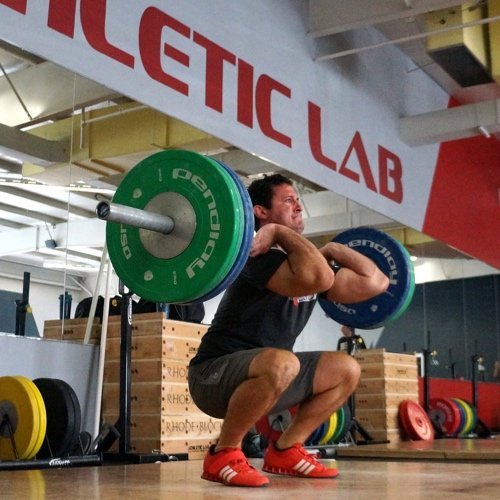
Athletic Lab is made up of a diverse group of goal-oriented and hard-working individuals. That's why we take a moment each month to highlight one (or more) of our members in our member of the month feature. For the month of March, we've chosen Delaney Register. Delaney has been a part of the Athletic Lab community since 2015 and is currently using our online training program. She recently came back from shoulder surgery and has been making great progress ever since; a great example of patience, hard work, and overcoming setbacks. For this month we are doing things a bit different with a video interview. You can check out our previous members of the month here. Name: Delaney Register What city were you born in Garner, NC What do you do when you're not working out at Athletic Lab (occupation, hobbies, etc) I work at IQVIA in contracts and proposals, and I am also currently planning a wedding for April 2019. What happened to your shoulder About 11 months ago I tore my labrum in my right shoulder. What has been the hardest part about coming back? Post surgery, the hardest part of coming back has been all overhead positions. What are some post-surgery achievements you have made so far? Starting to train with the online program and getting a 9kg PR on back squat. What's your least favorite exercise When my coach makes me run in the rain! Who do you look up to I look up to Brooke Ence because she just recently came back from a surgery as well, doesn't care what people think of her, and she pushes herself hard in the gym.

By |2018-03-02T12:26:59-05:00March 2nd, 2018|News|0 Comments

Re-coaching the Squat by Riley Edmonds

[Riley Edmonds from St. Bonaventure University in 2016 with a bachelor's degree in Exercise Science and is currently in the Coaching Mentorship Program at Athletic Lab.] Squatting is one of the most natural movements we do, and arguably one of the most important exercises we can use in training. The odds are everyone that has ever done any bit of exercise has probably been taught how to squat in one form or another. But what if I told you that what you were taught or are teaching is wrong? Okay, well maybe not totally wrong but certainly, the information currently in circulation by many coaches is a little outdated. Specifically, the idea that the knees should never pass the toes in a barbell back squat is wrong and should no longer be a common cue used by coaches. Imagine if you will two people, one fairly tall person and one fairly short person. In general, taller people have a relatively short torso but long legs, while shorter people have a relatively long torso but short legs. Now, when these two individuals perform a restricted squat, that is, a squat in which the knees are not supposed to pass the toes, the end result will be two very different looking squats. What you will probably see is the shorter individual will be able to squat just fine, keeping good posture and balance. (1) However, what you will typically see for a taller individual is a very hunched-over looking squat, with very poor posture and less balance. The simplest reason being that as the length of the leg, specifically the femur, increases relative to the torso, the center of mass will shift further backward, away from the [...]

By |2018-01-26T13:54:17-05:00January 26th, 2018|Training Info|0 Comments

The benefits of competing in the sport of weightlifting: Part One

"A long time ago in a training facility far, far away...." That's right, we said it. You heard it. You've probably watched it. The rumors are true. We're producing a special Five Episode Web Series leading up to our 2018 Winter Weightlifting Classic on Saturday, February 17. Coaches Chris and Brian are putting together five (that's right, count it one, two, three, four.... fiiifth) videos leading up to the event. This week we bring you a "Beginner's Guide to Competing" if you will. Chock full of color commentary and a light dash of science and psychology. So, pop your popcorn, make sure your smartphone is charged. Make sure you're following us on Facebook, Twitter, and Instagram, and subscribed to our YouTube Channel because it's about to get serious.... seriously, wild. We can promise you our series will be equal parts fun, informative, and engaging, and backed by science. We have created this pie-chart as proof: So if you haven't checked out our most recent video on why you should compete...no scratch that, think of it more as a video confirming your decision to compete, then fix your lookin' balls on the video at the bottom of this post. On a more serious note, please download the related supplementary material each week. This week's material is "A Complete Beginner's Guide to Competing in Weightlifting" packed with information on: how to register for an event, weight classes, a link to a downloadable version of the International Weightlifting Federation (IWF) handbook, and links to our very own Athletic Weightlifting Team. Enjoy and we'll see you in a week!

By |2018-01-28T13:28:20-05:00January 17th, 2018|Training Info|0 Comments

Benefits of Post Activation Potentiation by Michael Bruno

[Michael Bruno recently finished his undergraduate degree at West Chester University of Pennsylvania. He is currently in the Coaching Mentorship Program at Athletic Lab] Post Activation Potentiation (PAP) is a phenomenon by which muscular performance is temporarily enhanced as a result of the subsequent conditioning activity. PAP can be used to improve short-term performance in sprinting, throwing, swimming, and jumping capabilities. This is the underlying mechanism that training methods such as complex, contrast, and French contrast all seem to improve. Complex training involves a heavy compound exercise, followed by plyometric exercise with similar movement pattern (i.e. half squat and vertical jump), aimed at improving rate of force development or the ability to put force into the ground over a short period of time. Whereas contrast training is a heavy set followed by a relatively lighter set over a period of time, aimed at improving maximum strength with use of submaximal drop sets. Although there are many ways to implement PAP into workouts, we are still unclear as to the underlying physiology of PAP. In the past decade, there has been a significant amount of research done on PAP and rightly so because of its wide range of performance improvements. The research has shown that there are three proposed mechanisms behind PAP. The phosphorylation of regulatory light chains, increased recruitment of higher order motor units, and changes in pennation angle of the muscle fibers. Phosphorylation or the adding of a phosphate molecule is done through catalyzation of an enzyme called myosin light chain kinase. This kinase is activated when calcium molecules are released from sarcoplasmic reticulum during muscle contraction. After being released, they then bind to calmodulin. This phosphorylation is thought to potentiate subsequent contractions by [...]

By |2017-11-08T11:43:11-05:00November 8th, 2017|Training Info|0 Comments

High Frequency Training: Efficacy and Considerations for Athletic Performance by Frank Muntis

[Frank Muntis recently finished his Master's degree in Exercise Physiology from the University of Louisville and is currently in the Coaching Mentorship Program at Athletic Lab.] While there are countless variations of volume and intensity in resistance training programming, a commonly under-appreciated variable of periodization is training frequency. I first became interested in the subject about a year ago when I decided to try a high-frequency squat program to help me break a plateau I was in and saw incredible progress. I not only broke through my plateau, but it seemed as if I was setting PR's almost every other day. The more I explored the subject, the more fascinated I became. The Norwegian Frequency Project Many of you have likely heard of what is often referred to as the Norwegian Frequency Project. The study consisted of 16 elite competitive powerlifters, half men, and half women, between the ages of 18 and 25. They were split into either a high frequency (6day/wk) training program or low frequency (3day/wk) training program with the same exercises, routine and weekly volume held constant between the groups. The high-frequency group had nearly double the strength and hypertrophy gains as the low training frequency group[1]. It is important to note that these were not your everyday gym goer. The participants in this study were highly trained national level Norwegian powerlifters. This study has sparked a lot of interest into high-frequency training programs. It is my goal to speak about what the limited research indicates about the efficacy of these high-frequency programs and who they are best suited for. Effects on Neuromuscular Strength First, let's look at the possible effects of high-frequency programs on gains in neuromuscular strength. The literature is [...]

By |2017-10-23T15:22:07-04:00October 23rd, 2017|Training Info|1 Comment

Low Bar vs. High Bar Squat by Zach Chokr

[Zachary Chokr is a senior at North Carolina State University majoring in Psychology, minoring in Sports Science, and a Certified Personal Trainer under the National Academy of Sports Medicine. He is currently an Athletic Development Intern at Athletic Lab.] The squat has biomechanical and neuromuscular similarities to a wide range of athletic movements. Thus, it is one of the most frequently used exercises in the field of strength and conditioning; and is a core exercise designed to enhance athletic performance. In addition, it is an indispensable component of competitive weightlifting and powerlifting that is regarded as a cardinal test of lower-body strength (Schoenfeld, 2010, p. 3497). For some reason, the first question "gym bros" always seem to address is how much someone can bench press, but is that really defiant of your strength? There is no greater love-hate relationship than that of leg day; waking up in the morning with your legs so sore that you are forced to waddle helplessly like a penguin. But hey, on the bright side it shows you're working hard and I commend you for that. I promise, the more you do it, the easier it becomes. On the more technical side, once you are familiar with the back squat, there are variations that can be performed to adjust the angles and torques placed on the joints that affect the force applied to the low back, legs, and hip musculature by shifting the location of the bar on the back which can provide specific advantages to your personal goals. By changing the location of where the bar sits on your back, you are also changing the bar's center of gravity and where the load is placed through the body which [...]

By |2017-04-12T19:27:36-04:00February 14th, 2017|Training Info|0 Comments

I Choose You: Squat and Bench Press by John Vilardi

[John Vilardi is a recent graduate of Slippery Rock University and an Athletic Development Intern at Athletic Lab] The purpose of this blog is to compare and contrast the bodybuilding and powerlifting style squat and bench press. The squat and bench press are two of the most fundamental exercises, and when used properly can drastically add strength and muscle hypertrophy. First, let's start with the bodybuilding style squat and bench press. Bodybuilding Squat The bodybuilding style squat typically consists of a narrow stance (roughly shoulder width), and a high bar placement on the traps. The purpose of the bodybuilding style squat is quad development, so it makes sense that the bar is higher on the back, which shifts the center of gravity forward (Swinton et al., 2012) placing more stress on the quads, as well as forcing the lifter to keep their body more erect, again, placing a greater demand of quad activation. Another common theme with bodybuilding style squatting is the idea of time under tension, and using the greatest range of motion capable. The best way to increase time under tension is going through a full range of motion using different tempos (typically slow eccentric, as well as slow concentric, possibly with pauses at various depths). Bodybuilding Bench press The concepts here are very similar to the squat mentioned above. Essentially, for bodybuilders it is more important to go through a range of motion that works the desired muscle group in the most efficient manner (Clemson et al., 1997) (Wagner et al,. 1992). The bodybuilding style set up is typically more relaxed lower body, no arch in the back, and a hand grip where the forearms are perpendicular to the floor at the [...]

By |2017-04-13T10:53:40-04:00July 30th, 2015|Training Info|0 Comments

Squatting Our Way to Health, Moving Our Way Back to Life by Houston Deck

[Houston Deck is a recent graduate of Florida Atlantic University and an Athletic Development Intern at Athletic Lab] What's the largest organ in the body? Unless you're playing Jeopardy, skin isn't the answer. Doctor of bioenergetics Andy Galpin says, To be an endocrine organ, signals must be sent. And as of recent studies, muscle is actually our biggest organ. Muscle is sending signals to the brain, liver, immune system, nervous system, and skeletal system (Galpin, 2015). Because of this, overall muscle function and development is a direct link to our overall quality of life. Typically the more severe the chronic disease, the more sarcopenia and muscle atrophy we see; ultimately affecting our quality of life. With that being said, pound for pound (literally and figuratively), the back squat is one of, if not the best, resistance training exercises we could do for ourselves. But is it for everyone? What about your grandmother? What if I've had a back injury? Now, degrees of intensity and volume are an entirely different subject but the fact of the matter is everyone should squat to some degree. Dr. Andy Galpin made a fantastic point, if we stopped relying on prescriptions to aid in the heart's performance in elder adults and focus more on resistance training, reliance on the prescriptions and dosages would be affected drastically (Galpin, 2015). Why? Simply put, for many elderly individuals even simple tasks are a max effort attempt! Standing from a chair may take an elderly individual all they have because the muscles are so undertrained and resistance training isn't event being considered as a modality. That's why the heart rate spikes to drastically just to stand up, it's a max effort attempt! Let's look [...]

By |2017-04-13T10:54:07-04:00July 22nd, 2015|Training Info|0 Comments

The Effects of Squat Depth on Knees by Darius Marsh

[Darius Marsh is a student at ECU and an Athletic Development Intern at Athletic Lab] Do you ever have any knee pain when you squat or have to use accessories, such as wraps for relief during squats. For many athletes and the general population this is a normal occurrence. Many individuals say that knee pain can be due to technique for different squat variations, such as the back squat, front squat, and overhead squat. Although knee pain can be caused by technique, studies have used athletes and the general population's squatting depth to evaluate knee pain. Different squatting depths have effects on the knee, such as pain, force, and stability. In today's fitness world, many individuals are told to squat to parallel to avoid injuries to the lower extremities. Unfortunately, this is a false statement because parallel squats can actually cause more of a risk to your ACL and PCL. The squatting depth of the general population varies based on a person's knee pain. Squatting depths vary from different angles, such as regular squats between 60-70, a half-squat between 80-100, a quarter squat between 110-140, and a deep squat between 40-45 [1]. Prior research suggests that the deep squat presents an effective training exercise for protection against injuries and strengthening lower extremities [2]. In addition to knee pain, the squatting depth can affect the amount force put on the knee. The amount of force put on the knee can cause an individual to not squat as low as they desire due to discomfort. Individuals have various squatting depths to produce more or less force on the knee. One study suggests that peak ACL forces occur between 15-30 of flexion, decreases significantly at 60 and levels [...]

By |2017-04-13T10:56:26-04:00March 24th, 2015|Training Info|0 Comments

Squatting Tips by Carson Criswell

[Carson is a Exercise Science Major at North Carolina Central University and an Athletic Development Intern at Athletic Lab] When someone thinks of squats, their mind normally takes them to one of three theories; Great exercise, painful exercise, or the booty creator. All three of those theories can be true to an extent depending on your squat mechanics. There is a proper way to receive all of the benefits of a squat, and the key is form. Heels down please. Any one performance or fitness program typically includes a type of squat. It is inevitably, the king of full body exercises. Squatting burns fat, tones abs, improves core stability, and reduces back pain while also indirectly increasing grip and arm strength. The opportunities are seemingly endless. And here is an extra bonus for women who want that highly touted gluteus cuff, or almost perfectly symmetrical legs. There are many squat variations depending on what you're trying to accomplish but the traditional squat can truly answer most fitness prayers the safest. Not saying this is the only exercise you should do, but it could be the cornerstone for your entire work out. We have touched on a few important factors to remember and some benefits of squatting; now let's talk about how to properly perform a squat. There are a few safety precautions to be aware of and take before performing squats. First, one must understand the movements that will be made and the need for body symmetry. The goal is to move your body in a sitting motion back on your heels until the hips are parallel to the knees; followed by a surge of a push stemming from your heels through your legs pushing [...]

By |2017-04-13T10:59:53-04:00September 30th, 2014|Training Info|3 Comments
Go to Top