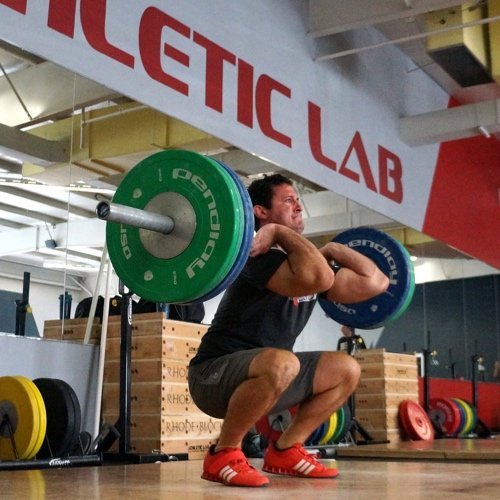
Squatting Our Way to Health, Moving Our Way Back to Life by Houston Deck

[Houston Deck is a recent graduate of Florida Atlantic University and an Athletic Development Intern at Athletic Lab] What's the largest organ in the body? Unless you're playing Jeopardy, skin isn't the answer. Doctor of bioenergetics Andy Galpin says, To be an endocrine organ, signals must be sent. And as of recent studies, muscle is actually our biggest organ. Muscle is sending signals to the brain, liver, immune system, nervous system, and skeletal system (Galpin, 2015). Because of this, overall muscle function and development is a direct link to our overall quality of life. Typically the more severe the chronic disease, the more sarcopenia and muscle atrophy we see; ultimately affecting our quality of life. With that being said, pound for pound (literally and figuratively), the back squat is one of, if not the best, resistance training exercises we could do for ourselves. But is it for everyone? What about your grandmother? What if I've had a back injury? Now, degrees of intensity and volume are an entirely different subject but the fact of the matter is everyone should squat to some degree. Dr. Andy Galpin made a fantastic point, if we stopped relying on prescriptions to aid in the heart's performance in elder adults and focus more on resistance training, reliance on the prescriptions and dosages would be affected drastically (Galpin, 2015). Why? Simply put, for many elderly individuals even simple tasks are a max effort attempt! Standing from a chair may take an elderly individual all they have because the muscles are so undertrained and resistance training isn't event being considered as a modality. That's why the heart rate spikes to drastically just to stand up, it's a max effort attempt! Let's look [...]

By |2017-04-13T10:54:07-04:00July 22nd, 2015|Training Info|0 Comments

The Effects of Squat Depth on Knees by Darius Marsh

[Darius Marsh is a student at ECU and an Athletic Development Intern at Athletic Lab] Do you ever have any knee pain when you squat or have to use accessories, such as wraps for relief during squats. For many athletes and the general population this is a normal occurrence. Many individuals say that knee pain can be due to technique for different squat variations, such as the back squat, front squat, and overhead squat. Although knee pain can be caused by technique, studies have used athletes and the general population's squatting depth to evaluate knee pain. Different squatting depths have effects on the knee, such as pain, force, and stability. In today's fitness world, many individuals are told to squat to parallel to avoid injuries to the lower extremities. Unfortunately, this is a false statement because parallel squats can actually cause more of a risk to your ACL and PCL. The squatting depth of the general population varies based on a person's knee pain. Squatting depths vary from different angles, such as regular squats between 60-70, a half-squat between 80-100, a quarter squat between 110-140, and a deep squat between 40-45 [1]. Prior research suggests that the deep squat presents an effective training exercise for protection against injuries and strengthening lower extremities [2]. In addition to knee pain, the squatting depth can affect the amount force put on the knee. The amount of force put on the knee can cause an individual to not squat as low as they desire due to discomfort. Individuals have various squatting depths to produce more or less force on the knee. One study suggests that peak ACL forces occur between 15-30 of flexion, decreases significantly at 60 and levels [...]

By |2017-04-13T10:56:26-04:00March 24th, 2015|Training Info|0 Comments

The Effect of Squats on Distance Running Performance by Darius Marsh

[Darius Marsh is a student at ECU and an Athletic Development Intern at Athletic Lab] Distance runners have all heard the myths or opinions that back squats are bad for distance running. Many people and coaches believe in order to become good or increase performance in distance running. You need to stay away from back squatting and just increase your mileage for the week. Unfortunately, this is a mistaken concept by many people today. In reality, the back squat can be beneficial and effective for distance running. When you think about it, most of the muscles being used for the back squat and distance running are the same such as gluteus maximus, hamstrings, and quadriceps. The beneficial effects that the back squat has on distance running are reduced risk of injury, increase in performance, and running posture. People are always concerned with pain and injury when they start distance running. An easy way to alleviate this problem is to implement back squatting into your training at least once or twice a week. "Back squatting will also help in making your muscles stronger surrounding a particular joint and creating more stability for that joint" [1]. These joints, such as the knee, can become more stable and have less pain during long runs. Back squatting can also help with recovery time for your legs after long runs throughout the week. If you're running at least four times a week this will help to lessen the fatigue after runs. As well as reducing the risk of injury, back squatting can help with increasing your performance in distance running. Back squatting a moderate or light amount of weight can help a runner in developing a faster tempo and being [...]

By |2017-04-13T10:56:49-04:00March 18th, 2015|Training Info|6 Comments

Three Reasons Why You Should Squat by Tim Ippolito

[Tim Ippolito is a student at ECU and an Athletic Development Intern at Athletic Lab] Back Squats...you either love them or hate them. Although back squats may not be everyone's favorite exercise, they may be the most beneficial. Back squats improve lower body strength. The primary muscle being used in the back squat is the quadriceps. The secondary muscles being used are the hamstrings, calves, glutes, lower back and core.[1] This is known by even some of the most novice weightlifters. However, the back squat does much more than just improve lower body strength. This blog will touch on three of the biggest benefits that the back squat improves. 1. Create An Anabolic Environment. No other exercises creates more of an anabolic environment than squats do. So what does that mean? By incorporating squats into your workouts, you will promote overall muscle growth across your entire body. Squats place your muscles under an immense amount of pressure. When your muscles are under pressure, they release a hormone called testosterone. When testosterone is released, it circulates throughout your entire body, which promotes muscles growth.[2] 2. Maintain Mobility. Researchers have determined that leg strength is key in maintaining mobility. As discussed earlier, squats do a tremendous job of increasing leg strength. By increasing leg strength, you can maintain mobility as you age. Some of the first research of its kind, done by Auburn University in 1989, determined that squatting regularly improved knee stability, strengthen connective tissues, and made these connective tighter and stronger.[1] Squats also have a large range of motion compared to other leg strengthening exercises. By doing a proper, below parallel squat, you can increase mobility. 3. Sport Performance. The first two benefits include general [...]

By |2017-04-13T10:56:50-04:00March 16th, 2015|Training Info|0 Comments
Go to Top