Athletic Lab Black Friday Specials

Athletic Lab is excited to announce Black Friday specials for the remainder of November or until supplies run out. Athletic Lab Coaching Academy The Athletic Lab Coaching Academy is offering 2 great deals for Black Friday. Athletic Lab is known around the world for our evidence-based and field-proven training methods. These methods have been applied to general population clients through elite professional athletes. CHPC Level 1 Course Through December 1st, our Certified High Performance Coach (CHPC) Level 1 Course is 30% off. The CHPC Level 1 course is the perfect introduction to our methodology. The course was designed as a launch pad to introduce coaches to the “Athletic Lab Way.” In just 1 year of availability, almost 1,000 coaches from around the world have taken the course. The CHPC Level 1 program provides coaches with a common ground so that they speak and understand the language of the field. Coaches will learn the fundamental sport sciences that our methods are based upon. The entire course is taught in a manner that can immediately be put into practice by coaches. The Level 1 course is beneficial for personal trainers, CrossFit coaches, Team fitness coaches and private sport performance coaches to learn the world-leading methods of Athletic Lab. Coaching Academy Gift Card Sale In addition to the course itself being on sale, our Coaching Academy is also offering 30% off virtual gift cards that can be used towards the CHPC Level 1 course. These gift cards make the perfect holiday treat for your favorite coach. After you purchase the gift card, you will receive an email containing a digital gift card and a unique coupon code good for 100% off the CHPC Level One course. It will [...]

By |2021-11-23T16:11:39-05:00November 23rd, 2021|News|0 Comments

Nutrition – A Practical Guide to Enhancing Performance (Part Two) by Beau Hains

[Beau Hains, MS is the Director of Team Training at Athletic Lab] In my previous blog, I broke down the first two major factors for nutrition, which you can check out here. Now, I will go into the remaining three factors: Nutrient Timing Food Composition Supplements Nutrient Timing Nutrient timing is all about when to take the appropriate nutrients throughout the course of a day. This general definition can be broken down further into two subdivisions, which are meal frequency and meal timing. Meal frequency refers to the overall number of meals that you consume in a day, while meal timing refers more specifically to the time of day that you consume the meal in relation to your activity. Before we get into what benefits optimal nutrient timing can offer, I believe it is important to first understand what it is less helpful for. As I mentioned in my last article, if you do not have a good foundation of calorie balance and macronutrient intake, then nutrient timing will have a less significant impact. The importance of nutrient timing, or lack thereof in some instances, is explained very well in the graphic below. Each macronutrient has a specific set of guidelines on when they should be consumed to ensure they are utilized optimally by the body. Protein consumption, much like was discussed in my previous article about macronutrient ratios, can be simplified based on your goals. The research seems to remain consistent in that if you consume protein with all meals over the course of the day, timing really becomes a relative non-issue. However, it is worth noting that consuming over 30g of protein in a single sitting will not add any additional benefits regarding [...]

By |2020-05-10T11:05:33-04:00May 11th, 2020|Nutrition Info|0 Comments

A Practical Look at HMB Supplementation Research and Application by Earl Wilcox

[This is a guest blog by Earl Wilcox. Earl is a graduate from the Kinesiology program at the University of North Carolina at Greensboro. Earl currently possesses his CSCS from the NSCA and is an Applied Sports Science Intern at Athletic Lab.] Beta-hydroxy-beta-methylbutyrate (HMB) is a supplement that is a byproduct of the breakdown of the amino acid Leucine, which plays a vital role in the regulation of protein synthesis. It is because of this relationship that HMB could help improve performance. There is no magic bullet when it comes to supplements and HMB is no different. However, there are a few circumstances in which it could assist athletes in performing better. Why would you need a supplement like HMB if Leucine is readily available in foods rich in protein, specifically animal proteins? The reason is that during the breakdown of Leucine, only 5% is converted into HMB (Wilson et al., 2013). To reach the recommended daily dosage of 3 grams of HMB, one would have to consume 600 grams of protein to reach this dosage, which would be the equivalent of 5.5 pounds (88 ounces) of steak throughout the day. There is a restaurant in Texas that will let you eat for free if you can eat their entire 72 oz. steak dinner in one hour. Pictured below is the size of their steak; now imagine having to add an additional pound to that steak. (Picture of steak) While this certainly might be a delicious option for some, it would not be sustainable from a caloric intake standpoint because that amount of steak would have a caloric price tag just shy of 6,800 calories! This would not align with our goal of increasing athletic [...]

By |2017-04-12T19:30:49-04:00August 12th, 2016|Nutrition Info|0 Comments

Guidelines for Post Workout Nutrition & Supplementation by Richard Bowie

[This is a guest blog by Richard (Lee) Bowie. Lee is an coach participating in our Coaches Mentorship program at Athletic Lab.] We've all had a day on which it takes every ounce of effort we can muster to stop the whirlwind of life going on around us and get to the gym. Even if it is just for a short period of time, it is one of those days where something is better than nothing. When we have a day like this, that chaos going on around us usually doesn't stop until we walk into the gym and it picks back up as soon as we take our first step out the door. This usually means that we fail to properly fuel our body for the workout or fail to properly fuel our body for recovery. Nutrition and supplementation are integral to fueling your body for each and every workout and allowing your body to recover each and every day. With this comes many different questions. Should I eat a real meal or have a protein shake? When should I have it? How much should I have? How soon before or after my workout should I eat? The questions can go on and on, but what is the right answer? The right answer is not as straightforward as one might think. The research in this area is not definitive one way or another. So where should you start in order to understand how to properly fuel your body for training and recovery? To do this, you must start with the principle that you want to minimize the amount of time your body spends in a catabolic state. Catabolism is the set of metabolic pathways [...]

By |2017-04-12T19:32:09-04:00July 7th, 2016|Nutrition Info|0 Comments

Creatine for Performance and Wellness by Earl Wilcox

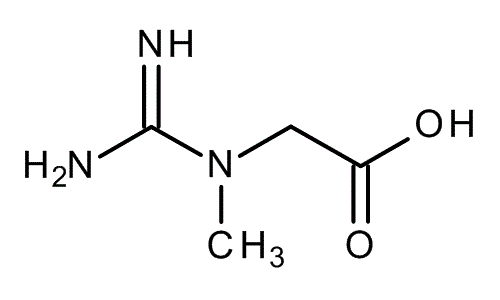
[This is a guest blog by Earl Wilcox. Earl is a graduate from the Kinesiology program at the University of North Carolina at Greensboro. Earl currently possesses his CSCS from the NSCA and is an Applied Sports Science Intern at Athletic Lab.] Creatine is one of the top supplements of choice for increasing athletic performance. According to the University of Maryland Medical Center, Americans spend around 14 million dollars a year on creatine supplementation. The main draw to supplementing with creatine is that it can help promote greater changes in muscle mass, body composition and strength gains when combined with the proper training regimen. However, supplementation may not just be for elite level athletes and those who are trying to look good come beach season. There are now studies that show creatine supplementation may in fact help in the treatment of Parkinson's disease as well as help prevent sarcopenia and traumatic brain injuries. Before we get into how creatine can help prevent these particular issues, I believe it is important to explain what creatine is and how it works. First of all, creatine is a naturally occurring substrate in the body and can be found in most animal-based proteins. It is used during the resynthesis of ATP. Think of ATP as the currency the body uses to perform any task; if you spend too much of it, you become unable to perform said task. The body has three different ways to produce ATP, one of which uses creatine. The phosphocreatine system. The phosphocreatine system can produce a vast amount of ATP, however it is limited to producing energy for up to 6-10 seconds. The phosphocreatine system would be like driving a Ferrari in a cross [...]

By |2017-04-12T19:32:28-04:00July 2nd, 2016|Nutrition Info|1 Comment

Caffeine: ?Benefits, Placebo, or Both? by Houston Deck

[Houston Deck is a recent graduate of Florida Atlantic University and an Athletic Development Intern at Athletic Lab] After oil, coffee is the second most valuable commodity in the world. More than 50 percent of Americans drink coffee everyday three to four cups each, more than 330 million cups a day and counting (Neal, 2002). Whether it's an average Joe looking for a pump after leaving the 9-5 or an elite athlete training full time, caffeine is highly sought after for its ergogenic benefits. Coffee, caffeine pills, powder, energy drinks and pre-workout supplements are all various forms of caffeine. How much does this drug actually benefit us within the weight room? First, let's understand what caffeine is and what it does. Caffeine is found in various plants as an alkaloid in the seeds, fruit and even leaves. It is the number one used drug in the world with 74% of all elite athletes reportedly consuming caffeine prior to competition (Coso et al., 2012). The drug is shown to increase calcium release and influence actin and myosin binding sites. This increase of calcium from the sarcoplasmic reticulum can increase and benefit both muscle contraction and duration of the contraction (Olorunshola, Kolawole V., Achie, L.N. 2011). Also, acute ingestion of caffeine is shown to delay time to fatigue. This is due to increased calcium release inside the muscle fibers and higher delivery of blood to muscles that are at work (Green et al., 2007). So when it's international chest day at the gym, how much of this caffeine is actually helping? In one study on caffeine ingestion and upper body resistance training, 5mg/kg bodyweight caffeine was given to 13 men who performed an average of 2.5 reps [...]

By |2017-04-13T10:54:38-04:00July 14th, 2015|Nutrition Info|0 Comments

Creatine: What all the fuss is about by Kelsey Haddock

[Kelsey Haddock is an Exercise Physiology student at the East Carolina University and is an Athletic Development Intern at Athletic Lab.] What do you think of when you hear the word creatine? Well, the first image that pops in my head when I hear the word creatine is a man in the weight room with muscles on top of muscles. My lack of research and knowledge about creatine influenced my attitude towards this must-have nutritional supplement. I never knew the many benefits that creatine supplementation has on the human body, many of which are not even related to increasing one's lean muscle mass. So in this blog, you will discover what all the fuss is about. Did you know our bodies naturally produce creatine? Creatine phosphate is a naturally occurring amino acid that is present in much living tissue such as the liver, kidneys, and pancreas. Creatine phosphate is stored in our muscles, where it can regenerate ATP, or in simpler terms, it can create energy during those high-intensity, short duration workouts4. Creatine's most popular use is to improve ones strength levels, and in return increase lean muscle mass. How? By producing enough energy for your body to train harder, and progressively overload your system. Progressively overloading your system gives the body the ability to gain strength and build more muscle tissue2. Chad Kerksick, Ph.D., assistant of exercise physiology at the University of Oklahoma puts it into simpler terms, If you can lift one or two more reps, or 5 more pounds, your muscles will get bigger and stronger? 3. Research has shown creatine is the most effective ergogenic nutritional supplement currently available to athletes in terms of increasing high intensity exercise capacity and lean [...]

By |2017-04-13T11:00:09-04:00September 9th, 2014|Nutrition Info|2 Comments

Creatine: More than just strength and power by Craig Kleinberg

[Craig Kleinberg is an Exercise Physiology master's student at the University of North Carolina and is an Athletic Development Intern at Athletic Lab.] Along with whey protein, creatine is one of the most researched performance supplements on the market. The science is pretty clear, yet there is still much confusion over the safety of this supplement. The official position of the International Society of Sports Nutrition states that there are little to no detrimental effects from supplementation and that it is one of the most beneficial aids for high intensity exercise capacity (1). Not only does strength improve, but there are also reports of up to a 30% increase in training volume (2,3). Additionally, supplementation has been shown to increase bone mineral concentration and density, thereby decreasing the risk of fractures that may eventually lead to bed rest and potentially mortality (4). Not only does creatine benefit the musculoskeletal system, there is a host of benefits for the brain. Studies show that upon activation of the brain, ATP remains constant but there is an immediate drop in phosphocreatine indicating an increased demand for energy (5). Similar to skeletal muscle, the energy byproduct lactate accumulates leading to decreased performance on cognitive tasks, also known as mental fatigue (6). Supplementation with creatine has been shown not only to decrease mental fatigue, but also increase performance on cognitive tasks (8,9). Where creatine really shines is the research starting to show improved recovery from traumatic brain injuries. Due to some obvious ethical issues, a majority of studies have been done in rat models, but the results look promising. To simplify the science, upon impact, there is a brief decrease in blood flow to injured area of the brain. This [...]

By |2017-04-13T11:01:10-04:00July 17th, 2014|Nutrition Info|0 Comments

FitAID Performance & Recovery Drink has arrived

As a promotional deal, for this week only (5/19 - 5/25) we will be selling FitAID for $2.00 a can. It is the perfect time to try the performance & recovery drink. After the promotion, FitAID can be purchased for $3.00 a can or by the case (24 cans). Cases can be purchased for $54.00 (a savings of $18)  

By |2017-04-13T11:02:36-04:00May 18th, 2014|News|2 Comments
Go to Top