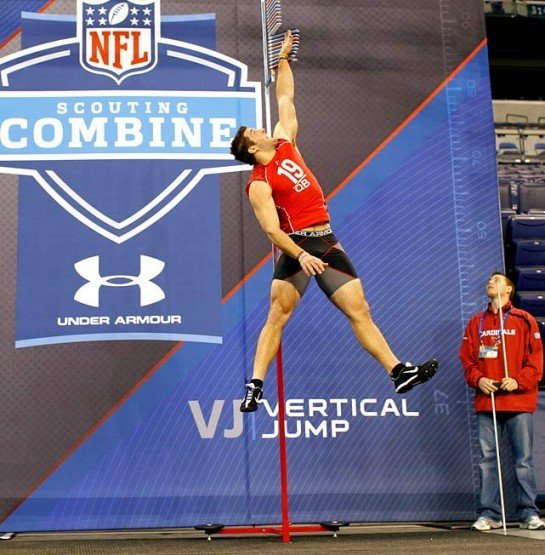
Athletic Lab hosts VTO Combine

Athletic Lab recently hosted a VTO Sports Combine. The event brought together 40 athletes from around the region to compete in a series of physical tests popularized by the NFL Combine. The 40 high school football players were assessed in the following tests: 40 yard dash Vertical Jump 5-10-5 (Pro Agility) 185 lb Bench Press L Drill Athletes assessed in the combine are eligible for a 20% discount on our Scholastic Sports Performance program.


By |2020-02-07T21:50:16-05:00February 8th, 2020|News|0 Comments

How to Increase Your Vertical Jump by Morgan Pillsbury

[Morgan Pillsbury is a recent graduate of Elon University and an Athletic Development Intern at Athletic Lab] In order to improve a skill you must practice it over and over again, right? Just repeat the movement back to back to back? Not quite. Maybe for something like coloring or playing an instrument, but when it comes to improving vertical jumping, that is not exactly a suggested plan of action. You may then ask: then what should I be doing in order to increase my vertical jump height? Since the movement requires a great amount of force production, as well as a high rate of force production, power is essential. Power is defined as the amount of work done in a certain amount of time, otherwise known in your body as how quickly and forcefully your muscles can contract. The best solution to increasing this power is a mix of strength training and plyometric training (PT) exercise regimens. Strength training should focus on power cleans, specifically midthigh power cleans and midthigh clean pulls. These two variations have been proven to be most advantageous in improving rate of force development and peak vertical ground reaction forces, which I just mentioned are the two essential pieces of a high vertical jump (Comfort et al., 2011). The other exercise is a deep squat (either front or back), which has been observed to significantly increase the squat jump (SJ) and countermovement jump (CMJ) heights (Hartmann et al., 2012). Whereas, quarter back squats actually produced significant transfer losses in explosive strength behavior, which the researchers attributed to less usage of hip and knee extensors compared to deep squats (Hartmann et al., 2012). However, as stated earlier, PT must not be left [...]

By |2017-04-13T10:54:16-04:00July 19th, 2015|Training Info|2 Comments
Go to Top