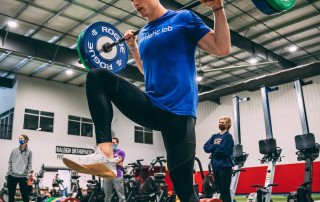
What’s More Important: Strength or Power?

[This is a guest blog by Caleb O’Brien who is a recent graduate from Appalachian State with a bachelor’s in exercise science. He grew up playing soccer his whole life, competing in the US Youth National League. He is currently taking part in the Athletic Lab Coaching Mentorship program.] Strength and power are often two terms that people throw around in the gym interchangeably. While both affect how well a lift is accomplished, they are not the same. Strength measures how much force your muscles can produce. Power, sometimes referred to as explosive strength can be described as the amount of work performed over a given period of time. The main factor that differentiates the two is that power accounts for the amount of time it takes to overcome the resistance. The variable of time refers to how quickly, or the speed at which an individual can execute the movement. In layman’s terms, power is the product of two key components; speed and strength. Outside of the technical differences within each of their respective definitions, the application of either strength or power heavily influences how one trains and formulates a program to favor one more so over the other. Three important variables that scope any training program and especially strength training are intensity, volume, and frequency. Intensity, simply put, is the amount of energy required per unit of time. Intensity can be measured by a handful of methods, such as RPE (rating of perceived exertion) and RIR (reps in reserve), which are two quick simple ways to gauge an individual's intensity day to day. Basing intensity off percentages of 1RM or rep maxes is a great way to hone in on what an athlete’s working [...]

By |2022-11-10T23:00:54-05:00November 11th, 2022|Training Info|2 Comments

Velocity based training – What we need to know by Nemanja Markovi?

[Nemanja Markovic earned his undergraduate degree at the University of Montenegro, where he also works as a personal trainer and S&C coach. He is currently in the Coaching Mentorship Program at Athletic Lab] I was almost finished writing this article, but then I saw Mike Young's quote on Science for sport's Instagram profile, "Applying insane forces, in the correct direction, over ridiculously short periods of time, is a trademark of the fastest people". Behind the following text is a coach with insane intention to put ridiculously useful information in the correct direction, with the belief that athletes with great performances are the trademark of the smartest coaches. Before you shoot the messenger I hope that you saw the humor in the last sentence. I also believe my respected fellow coaches when we decide to enter the field of strength and conditioning, that the biggest bang for our buck is enhanced performance and injury prevention. We can agree that there appears to be, among other things, the true need to get through planning and programming until we achieve precise individualization of training. Having this in mind, the autoregulatory training method is the right choice for coaches. As we know power is the product of force and velocity. In the last decade, thanks to numerous research findings, the role of velocity as an important parameter for estimating and monitoring the optimum intensity during strength and power training has emerged on the surface. Regardless of the increasing popularity, velocity based training (VBT) is for sure a useful method bringing a lot of benefits of improving the performance of athletes. Making a long story short, as I still continue down the path of learning about VBT, the purpose of [...]

By |2017-08-11T18:16:26-04:00August 11th, 2017|News, Training Info|0 Comments

Static Stretching and Explosive Activity by Vincent Ragland

[Vincent Ragland is in his last semester as a student-athlete at East Carolina University, pursuing a Health Fitness Specialist Degree. He is currently an Athletic Development Intern at the Athletic Lab] For many years, athletes across the world were taught the importance of static stretching before explosive exercises, such as sprinting, jumping, and throwing. The thought process behind it was that static stretching was a good way to loosen the muscles before exercise and help prevent injuries. Static stretching is, in essence, holding a stationary position and stretching a particular muscle further than its resting length. Some of the more common static stretches include the butterfly stretch, which stretches the inner thighs and hips, and the seated hamstring stretch. Muscles are usually stretched to a point where discomfort is reached, and are usually about 20 - 30 seconds in length. As time went on, researchers ultimately began to discover that static stretching had no noticeable benefits in terms of power output. Instead of better preparing an athlete for athletic activity, static stretching simply elongates and relaxes the muscles, it doesn't get them ready to generate force (Lebo et. Al 2014). In fact, having a small amount of tension and tightness in the muscles helps them to contract and produce more power. By doing static stretches before power based movements, athletes are stretching some of the desired power out of their muscles. I'm sure a lot of you all reading this blog have heard the phrase "a longer muscle is a stronger muscle". Coaches and athletes should be sure not to take this statement out of context. Static stretching does, in fact, lengthen the muscle. As previously stated, muscles need some tension and tightness in them [...]

By |2017-07-01T12:49:10-04:00July 3rd, 2017|Training Info|0 Comments

Athletic Lab Sport Performance Podcast: Episode #7 – Dan Baker

Episode #7 of the podcast features Dan Baker. Dan is a strength and power coach, researcher, and educator. Dan has a PhD in sport science specializing in velocity based training, and strength and power training. Dan was the strength coach for the Brisbane Broncos for nearly 20 years and won league titles in 1997, 1998, 2000, and 2006. Dan also serves as the president of the Australian Strength and Conditioning Association. This podcast will discuss many aspects of velocity based training protocols and his experiences with the technology over the course 20 plus years. Topics include: The availability of velocity based training (VBT). How the use of VBT changed over the years. VBT and intent during the session. Prediction of 1RM power and strength tests using VBT. VBT as a means of measuring readiness. How to lift hard and stay fresh during the in-season. Coaching intuition.

By |2017-04-12T19:29:14-04:00October 28th, 2016|Podcast|0 Comments

Stability Precedes Power by Pierrie Miller

[Pierrie Miller is an Athletic Development Intern at Athletic Lab] As the spring approaches, team sports increase in popularity, rather you're an athlete who is in the beginning of their season or coming toward the end of a season, injury prevention is always important. As trainers it is our job to ensure that our athletes are prepared for the rigors of a long season. Training requiring a strong mix of strength, power, flexibility and stability is often used to prepare athletes for performance. Often times we hear athletes express the want to be more "powerful", but less often do we here athletes express the need to be more stable. The idea of training to be more stable might seem silly at first, but it is difficult to perform powerful movements dynamically without a certain amount a stability. This is why we must look at some of the benefits of dynamic stability training. Popular magazines and television often show people conducting stabilization exercises on balance beams, stability balls, and other various forms of unstable surfaces. The truth is, although this looks interesting, it does not necessarily carry over to sports performance. Dynamic stability can be defined as, the process of the hip, knee, and ankle complexes to perform functional movement patterns at high levels without the feeling of slipping or giving away (wilkstorm et al. 2006). The muscles that surround the joints of the human body require a certain amount of stiffness in order for our bodies to maintain an upright posture. Without a certain joint stiffness individual joints may become hyper flexible, which my leave us at risk for injury, preventing this injury is top importance for all trainers. Injuries to lower extremities can happen [...]

By |2017-04-13T10:56:42-04:00March 20th, 2015|Training Info|0 Comments

Important factors to address in a softball-specific training program by Kelsey Haddock

[Kelsey Haddock is a Health Fitness Specialist Major at East Carolina University and an Athletic Development Intern at Athletic Lab] Conditioning has not played a huge role in softball, and now-days most of the general training programs softball players are following do not exactly meet their sport-specific needs. Since softball incorporates many skills, and one of the most important being the ability to react proficiently to every aspect of the game, a softball-specific training program is crucial in order to maximize this ability. In order to be able to design a softball-specific training program we must first understand the specific demands of the game. In this article I will address important factors a softball player must train in order to improve and maximize their athletic performance. Energy Systems: In terms of metabolic training, softball players should train overall fitness in the off-season, but the most important factor to train is the ability to make explosive movements for a short period of time. Therefore, it is the ATP-PC energy system that fuels just about every action in softball. Training the ATP-PC energy system involves sessions of repetitive 10-15 second bouts of maximum intensity work, with approximately two minutes of rest in-between to allow the system to replenish itself. Note that when conditioning ATP-PC system, it is very important to build in plenty of rest. It is also important to stop the training session if the quality of the movements or the players power decreases significantly, because when this happens you are beginning to work on power-endurance, which is counterproductive if your goal is to only increase the ATP-PC systems capacity. Strength: The key here is developing muscular power, power is a function of speed + strength. [...]

By |2017-04-13T10:59:57-04:00September 16th, 2014|Training Info|9 Comments

Training For Power In Baseball

[Casey is an Exercise Science student at ECU and is an Athletic Development Intern for Athletic Lab] Power is defined as the rate of performing work and is expressed as work divided by time or force times velocity.(2) In regards to the human body, it is the muscles? ability to produce as much force as fast as possible. Athletes with more fast twitch muscle fibers, which are responsible for short-duration anaerobic activities, are typically capable of producing more power.(3) Explosive power is one of the most important components of fitness for an athlete to possess to be successful, regardless of their sport. For a baseball player, it can be the difference between safely stealing second or being thrown out by a step. Hitting that game winning homerun with two outs in the state championship or making the final out at the warning track. Incorporating power training in the athlete's strength and conditioning program is imperative to avoid the latter of the two in these scenarios. So we know power training is a must for baseball, but what exercises or lifts should we incorporate to stimulate these fast twitch muscle fibers. Unfortunately, this is where it can get tricky. The Olympic lifts (snatch, clean, jerk) are one of the best tools to develop explosive power and are used worldwide. However, for years there has been a constant warfare going on between strength and conditioning coaches/trainers on whether these lifts should be included in the training of a baseball player. One coach will regularly utilize the Olympic lifts in his/her program while another coach would not dare use this form of training on his/her athlete. The lifts are either hated or they are loved. Rebuttals can be [...]

By |2017-04-13T11:03:06-04:00April 1st, 2014|Training Info|1 Comment
Go to Top